CROSLEY
Minibilen som kom 30 år för tidigt!

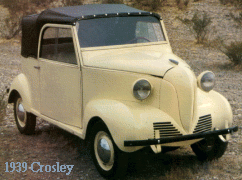 Fast inga försäljnings rekord sattes det första modell året, såldes ändå tillräckligt många bilar för att övertyga Crosley att fortsätta med 1941års modell, med flera olika karosstyper.
 Inför 1941, hade vagnparken expanderat till att inkludera, förutom de 2-och 4-passagerar cabrioleterna, en cabriolet sedan (den hade fönster för baksätes passagerarna), en stationsvagn, en "panel truck", en pickup, och två unika modeller som kallades "Parkway Delivery" och "Covered Wagon". Parkway delivery var en mini-panel-truck utan tak över framsätet, exponerande förare för elementen. Detta ansågs mycket elegant på '30'talet, särskilt om föraren var klädd i kostym som en chaufför. Den täckta vagnen var en cabriolet pickup truck med ett löstagbart baksäte. Med taket på plats kunde den användas som personbil, medans med allt borttaget så vart den en 1/4-tons pickup lastbil. Båda dessa två modeller har ett stort samlarvärde idag, då de flesta av förkrigstidens produktion bestod av cabriolet, coupé och sedan modeller.
 (Översättningsarbetet fortsätter långsamt): Prices for the expanded 1941 line ranged from the 950 lb. 2-passenger convertible at $315 f.o.b. all the way up to the 4-place station wagon, tipping the scales at 1160 lbs. and costing $470. This was the year that a Cadillac Fleetwood cost $2195, and a Lincoln Continental convertible cost $2700.
 World War II found the Crosley factory in Cinncinnati turning out military equipment, and Powell Crosley thinking of the improvements he would make in the postwar models. Gasoline rationing during the war had suddenly put Crosley ownership in a new light for many people. At 50 miles per gallon, even a 3-gallon "A" coupon went a long way. Crosley found one of the things he was looking for in the radically new 4-cyl. engine designed by Lloyd Taylor, of Taylor Engines in california. Taylor developed his engine under a Navy contract for a lightweight generating set for use on PT boats and for gun turrets on amphibious landing craft. The engine included such advanced features as an overhead camshaft, high compression and five main bearings. The most revolutionary feature, though, was the method of block construction. First of all, this was in unit with the cylinder head and detachable from the crankcase. Secondly, and more important, instead of beeing cast as all other engine blocks were and are, it was buildt up from an assembly of steel tubing and stampings. These parts were assembled in a jig, then copper brazed together at high temperatures, which also served to heat treat the cylinder walls and valve seats to bring them up to a high degree of hardness. Water jackets and passages were lined with a plastic material for anti-rust purposes, and all outside parts had some kind of stiffening ribs or fins cast into them for high rigidity. Machining operations consisted of trueing the bottom of the block where it meets the crankcase, boring the camshaft bearings and boring and honing of cylinder walls and cam follower guides. The block was bolted to the aluminium crankcase, with the hold-down bolts also serving as bolts for the main bearing caps.
 Crosley tested one of the generator sets for a continous wide-open run of 1200 hours, or almost two months. The only problem that occurred was in the exhaust valves due partly to the 100-octane unleaded aviation fuel it was running on. Carburetor was by Tillotson again, and still without an accelerator pump.
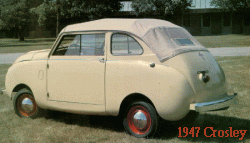
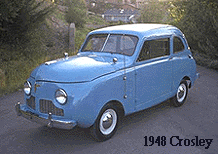
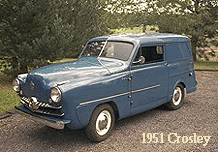 Shortages of materials and strikes made new car production a shaky thing at best in the months right after the end of the war, while at the same time a car hungry public was ready to buy anything with four wheels and an engine. Crosley leapt into the gap, and even though his suppliers couldn't provide nameplates for the first cars off the line, he had the name painted in red on the front and rear bumpers, 3-ins. high, and shipped the cars off to the dealers. Any color you wanted was available, so long as you wanted grey with red seats and wheels. Later, a convertible was added to the line. This was a European-style body, in which the sides and doors, including all glass, remained the same as in the sedan. Three removable bows supported the top fabric, which was simply snapped on at the rear, stretched over the bows and snapped on at the windshield. If the car was used open for any length of time, the top fabric would shrink slightly, and it became a considerable job to put the top up.
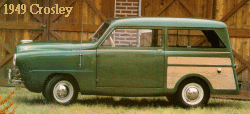
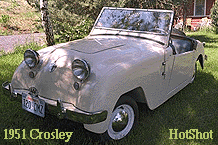 Crosley was not having so much luck with the rest of the line, even though roll-up windows were now available, along with cloth upholstery on the sedans and wagons, and a more modern front end and dashboard. Standard-sized cars were easy to get by the early '50's, and Crosley couldn't keep his prices low enough to compete. Production dwindled in 1951 to only 300 cars per month, and by 1952 Crosley sold out the automotive plant to General Tire and Rubber, who had no interest in making automobiles. The sale of the stock brought $68.000, and ended Crosley's dream of becoming another Henry Ford.
 Super Sports |
 Super Sports |
 '50 FarmOroad |
 '49 Panel Delivery |
 '49 Panel Delivery |
 '48 Station Wagon |
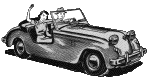
 '52 Super Sports |
 '51 Wagon |
 '47 Pickup |
 '47 Pickup |
 '47 Station Wagon |
 '51 Station Wagon |
 '52 Sedan |
 Many Roadsters |
 '51 Super Sports |
 Custom Super Sports |
 '37 Crosley Prototype |
 '37 Crosley Prototype |
 '42 Liberty Sedan |
 '42 Liberty Sedan |
 Crosley Tractor |
TUG |
 Crosley Devin |
 Custom Antique |
 Super Sports |
 '52 Super Sports |
 '47 Pickup |
 Hot Shot |
 Super Sports |
 '47 Pickup |
 '47 Pickup |
 Crosley block 46/49 |
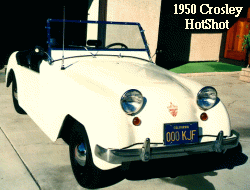
 '50 Hot Shot |
 '39 Crosley |
 Crofton Brawny Bug |
 Prewar in van |
 FarmOroad |
 Hot Shot w. Gorilla |
 FarmOroad |
 Row of 46/48:s |
 Six FarmOroads |
 '51-52 Wagon |
 '51-52 Wagon |
 '49-50 Sedan |
 '49-50 Pickups |
 '49-50 Conv. Sedan |
 '49-50 Conv. Sedan |
 '50 Flatbed Pickup |
 Indian w. C.engine |
 CC 'Shorty' |
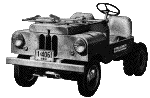
 Orchard Sprayer |
 '47 Street Rod |
 '47 Street Rod |
 Custom Hot Shot |
 '49 Darin Crosley |
 Midget Racer |
 Crosley Junk |
 '47 Pickup |